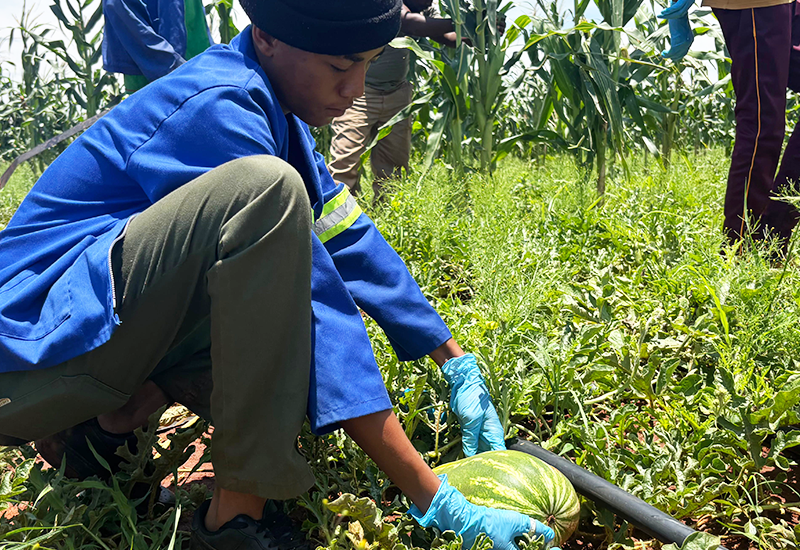
Before SAFE was a registered organisation, we were already farming. Our 2024 pilot produced over 400 watermelons from our first planting season in Zebediela. More than 30% was sold to local informal traders and spaza shops; a further 30% was donated directly to community families. The rest sustained the team.
When disease affected part of the crop, we didn’t hide it — we ran soil tests, investigated the cause, and built those lessons into 2025 planning. That’s agricultural science in practice.
Milestone 2: The 2025 Maize Harvest
In 2025, SAFE cultivated two hectares of maize through an intercropping system — our first official revenue stream as a registered organisation. We hired three additional team members, expanded our farm workforce, and sold maize at R5 per cob outside Zebediela Plaza and Mehlareng Plaza. When stock neared the end of its fresh window, we grilled and sold it — zero waste, maximum value.
2025, SAFE hosted its inaugural Agricultural Sciences Workshop — a full-day, practical learning experience for Grade 11 learners from Kgakala Secondary School and Madibo High School. Learners got hands-on exposure to farming, soil science and crop management. Both schools responded positively and have expressed interest in continued partnership.
Milestone 4: Dithlakaneng Primary School Session — April 2026
On 20 April 2026, SAFE’s workshop facilitator hosted a session at Dithlakaneng Primary School focused on permaculture, gardening, and small-scale food production. Young learners discovered that farming isn’t just something you read about – it’s something you can do, starting today.
Milestone 5: National Recognition — CIPC 2026 Youth Awards
SAFE co-founder Pakane Kekana was selected as a top 15 national finalist at the CIPC 2026 Youth Awards, placing second in the Women Shaping IP category. This recognition affirms that what SAFE is building isn’t just locally significant — it’s nationally relevant.